
Nearly 20 million tons of polymer composite materials are produced around the world every year, and the market is growing by some 5% annually. That's according to JEC, an international composites-industry organization, which puts the rapid growth down to these materials' high performance, light weight and ease of use. This ideal combination of properties means the composites have been widely adopted in a range of industries, from aerospace and automotive to sporting equipment and wind power. But their popularity means manufacturers are having to quickly implement solutions to minimize the composites' environmental impact, as they are currently difficult to recycle. That's where CompPair's revolutionary technology comes in. Its self-healing composites, which can repair themselves in just a few minutes, can lengthen a product's lifespan considerably. Studies have shown that the same sample of a CompPair composite can repair itself up to 60 times without any change to its properties. The firm recently raised just under CHF 1 million in its first fundraising round—a milestone that will allow the young business to hire more staff, expand its premises, and ramp up its production capacity in order to support its market penetration.
Cutting repair time by a factor of 400
"An acquaintance of mine helps repair boats for the America's Cup, and says that a huge amount of time is spent after each race spotting and repairing places where the boat has been damaged. We're talking several hours, if not several days. Because once they've spotted a crack or dent, for example, they have to cover it with a patch of material, heat the patch and then polish the new surface. But our composites can cut the repair time by a factor of 400," says Amaël Cohades, CompPair co-founder and CEO. He illustrates his point with a neat demonstration at the company's premises: first he throws a pétanque ball hard at a sample of the composite, creating a large dent, then heats the dent with a hot-air gun. Just one minute later, the dent is fully repaired. Articles appearing in JEC Magazine and Frontiers explain that after the composite is repaired, it's just as crack resistant as the original.
CompPair was spun off of EPFL's Laboratory for Processing of Advanced Composites (LPAC) one year ago. It has already introduced its first family of composites, called HealTechTM, which are sold as prepegs and can be draped, tacked and cured just like conventional polymers. "We offer an array of fiber architectures that can be used in all sorts of applications, such as sporting equipment, wind turbines and boat hulls," says Cohades, showing us a palette of samples with various textures made from fiberglass and carbon fiber. The startup is working with several other companies to integrate its composites into their products.
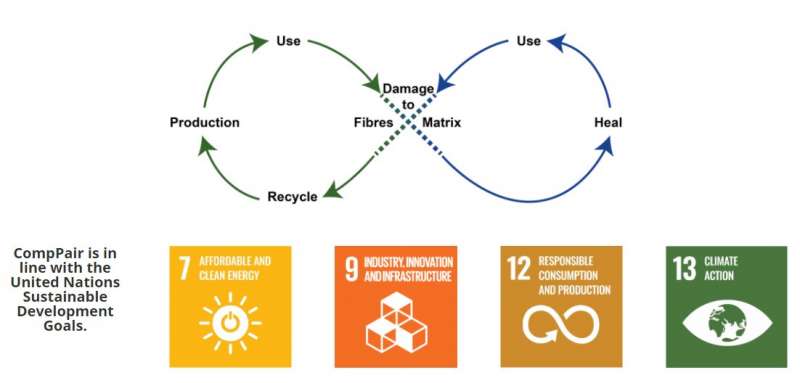
CompPair's patented technology gives materials the ability to heal themselves, much like the human body in response to a wound. But how does it work? "The secret lies in a unique resin that we developed. When heat is applied, part of the resin becomes activated and undergoes a phase change that triggers the physical mechanisms involved in the healing process. As a result, the tears and cracks in the composite are repaired automatically," says Robin Trigueira, CompPair co-founder and CTO. "In addition, our composites don't lose any of their structural properties during the repair process, which means there's no risk of deformation. That makes them well suited to a broad range of applications."