Cost, Effectiveness, and Deployment of Fuel Economy Technologies for Light-Duty Vehicles
The light-duty vehicle fleet is expected to undergo substantial technological changes in the coming decades. New powertrain designs, alternative fuels, advanced materials and significant changes to the vehicle body are being driven by increasingly stringent fuel economy and greenhouse gas emission standards. By the end of the next decade, new vehicles will be more fuel efficient, lighter, emitting less air pollutants, safer, and more expensive to purchase relative to current vehicles. Given their increased efficiency, these vehicles will be less expensive to fuel than in the absence of such standards. Though the gasoline-fueled spark ignition (SI) engine will continue to be the dominant powertrain configuration even through 2030, such vehicles will be equipped with advanced technologies, materials, electronics and controls, and aerodynamics. And by 2030, the deployment of alternative methods to propel and fuel vehicles and alternative modes of transportation, including autonomous vehicles, will be well underway. In this context, the US Department of Transportation’s National Highway Traffic Safety Administration (NHTSA) requested that the National Research Council (NRC) study the costs, benefits, and issues related to the implementation of new light-duty vehicle technologies.
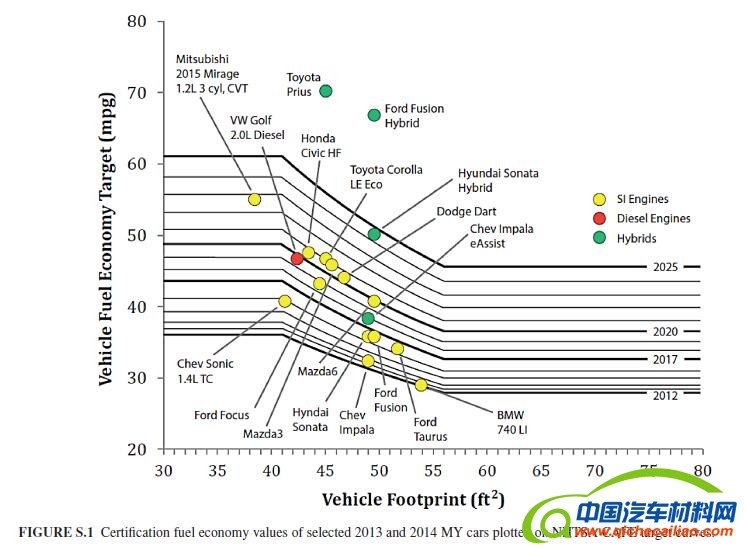
NHTSA is responsible for fuel economy standards and, together with the US Environmental Protection Agency (EPA), has been progressively tightening Corporate Average Fuel Economy (CAFE) and greenhouse gas (GHG) emission standards. The most recent set of CAFE/GHG standards, termed the National Program,1 cover model years (MY) 2017-2025 and call for an average light-duty vehicle fleet fuel economy of 40.3-41.0 miles per gallon (mpg) by 2021 and 48.7-49.7 mpg by 2025.2 The carbon dioxide (CO2) emission standard by 2025 is 163 grams/mile, which is equivalent to 54.5 mpg if vehicles were to meet this CO2 level entirely through fuel economy improvements.3
Recognizing the uncertainties for setting standards out to 2025, NHTSA is committed to a mid-term review to evaluate progress. Furthermore, under the provisions set out by the Energy Independence and Security Act of 2007, NHTSA does not have the statutory authority for setting CAFE standards for greater than five years at a time; thus, only the MY 2017-2021 CAFE standards can be considered final. Therefore, beginning in 2016, NHTSA and EPA will coordinate a mid-term review that must be finalized by April 2018. In conjunction with EPA and the California Air Resources Board, NHTSA will perform a joint technical analysis as part of its rulemaking for the MY 2022-2025 standards. This NRC study is designed to feed into the mid-term review and provide an independent review of technologies and the CAFE program more generally. The full task statement is in Appendix A.