Kordsa explains that chassis components are a unique opportunity for compositesbecause they comprise the largest single percentage of the vehicle weight, yet they are structural parts under repetitive dynamic loads.
The goal for Kordsa and Ford Otosan is to reduce CO2emissions and enable increased fuel efficiency and payload by producing a composite leaf spring to reduce weight 75% versus steel. This would also reduce the vehicle’s unsprung weight mass for follow-on weight reduction in other systems and improved comfort via reduced noise, vibration and harshness (NVH) levels.


Kordsa and Ford Otosan chose prepreg compression molding for its ability to deliver homogeneous resin distribution and optimized stiffness via improved fiber alignment with less distortion and reduced thickness variation, in a process offering high reliability and repeatability. Kordsa produced a variety of unidirectional carbon fiber and glass fiber/epoxy prepreg batches and performed full materials characterization on each, developing the materials data needed by Ford Otsan for input into computer-aided engineering (CAE) tools. It then worked to fully detail the load case for a prototype heavy truck leaf spring and used fiber bragg grating (FBG) sensors to verify loads and explore production parameters as well as fatigue properties.
The final prototype achieved 75% weight savings versus steel while increasing tensile strength, compression strength, and fatigue resistance. Kordsa will continue development with Ford Otosan and other transportation manufacturers, proving itself as a valuable ally in the campaign to reduce CO2emissions globally by lightweighting cars, trucks, aircraft and ships through lighter weight composite structures versus heavier steel, aluminum and magnesium alternatives.
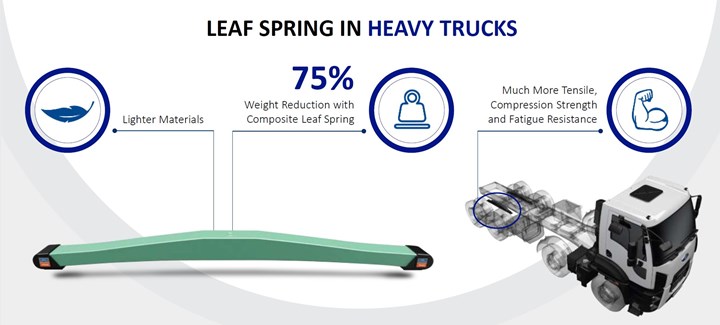
SOURCE | Kordsa and Ford Otosan