The Automotive Division of the Society of Plastics Engineers(SPE, Bethel, Conn., U.S.) recently concluded two rounds of judging on its 49th annual Automotive Innovation Awards Competition. On Nov. 6, the group held its 49th annual Automotive Innovation Awards Gala in the Detroit suburbs, where its members handed out trophies to finalists, category winners and the Grand Award winner, which were selected after prequalification and two rounds of judging by industry experts and members of the media.
This year, winning nominations and their development teams were honored by SPE in the categories of additive manufacturing, aftermarket and limited-edition/specialty vehicles, body exterior, body interior, chassis/hardware, environmental, materials, powertrain and process/assembly/enabling technologies. Additionally, SPE gave out awards to its Hall of Fame, Lifetime Achievement and Vehicle Engineering Team Award winners.
2019 Finalist, Category and Grand Award Winners
Note: a † denotes that the entry is a composite part.
Grand Award Winner
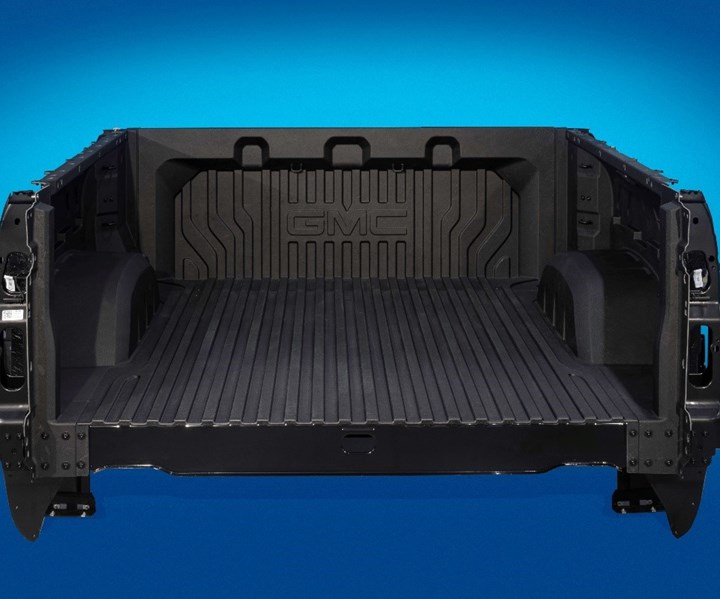
Winner of the overall Grand Award and also the Body Exterior category is the composite pickup box on 2020MY GMC Sierra Denali and AT4 pickups from General Motors Co. (GM, Detroit, Mich., U.S.). The CarbonPro box is the industry’s first thermoplastic composite pickup box compression molded in Sereebo carbon fiber/polyamide 6 composite from Teijin Ltd. (Tokyo, Japan).
Additive Manufacturing
Category winner: Sunglass bin on 2020MY Ford Explorer sport-utility vehicles (SUVs) from Ford Motor Co. †
Additional category finalists:
- Lug-nut starter on 2019MY Chevrolet Silverado pickups from General Motors Co.
- Instrument-panel delete plug on 2019MY Ford F-150 Raptor pickups (China market) from Ford Motor Co.
Aftermarket and Limited Edition/Specialty Vehicles
Category winner: Multiple additively manufactured components on 2020MYJaguar XE SV Project 8 supercars from Jaguar Land Rover Ltd.
Additional category finalists:
- Full-length side storage box on 2020MY GMC Sierra/Chevrolet Silveradopickups from General Motors Co. †
- Illuminated emblem light guide on 2020MY GMC Sierra pickups & YukonSUVs from General Motors Co.
Body Exterior
Category winner: Composite pickup box on 2020MY GMC Sierra Denali and AT4 pickups from General Motors Co. (also Grand Award winner) †
Additional category finalists:
- Active air deflector on 2020MY Ram pickups from FCA NA LLC †
- Front-end module with structural bolster and integrated active grille shutter system on 2020MY Ford Explorer and Lincoln Aviator SUVs from Ford Motor Co. †
- Glass-run sealing system on 2020MY Ford Explorer SUVs from Ford Motor Co.
Body Interior
Category winner: Integrated button carrier modular strategy on 2020MYExplorer/Aviator/Corsair SUVs from Ford Motor Co.
Additional category finalists:
- Glove-box latch on 2020MY Ford Explorer SUVs from Ford Motor Co. †
- Seat-back suspension system on 2019MY Lincoln Aviator SUVs from Ford Motor Co.
Chassis/Hardware
Category winner: Rear-differential module front bracket on 2020MY Jeep Cherokee SUVs from FCA NA LLC †
Additional category finalists:
- Window regulator plastic fastener on 2020MY Ford Explorer & Lincoln Aviator SUVs from Ford Motor Co.
- Precision wheel-balance system on 2019MY Chevrolet Corvette sports cars from General Motors Co. †
- Particulate matter air sensor on 2020MY Lincoln Aviator SUVs from Ford Motor Co.
Environmental
Category winner: 100% post-consumer recycled carbon canister on 2019MYFord Mustang sports cars from Ford Motor Co. †
Additional category finalist:
- Rice hull-filled polypropylene on 2019MY Ford Edge SUVs from Ford Motor Co. †
Materials
Category winner: Glass wool-reinforced composites for improved scratch resistance on 2017MY Hyundai Elantra sedans from Hyundai Motor Co. †
Additional category finalists:
- LED front fog lamp on 2020MY Ford F-150 pickups from Ford Motor Co.
- High-gloss black molded-in-color wiper motor cover on 2020MY Chevrolet Suburban SUVs from General Motors Co.
- Steering wheel bezel on 2020MY Ford F-250 & F-350 pickups from Ford Motor Co.
- SMC/LMC rear trunk components on 2020MY Chevrolet Corvette sports cars from General Motors Co. †
Powertrain
Category winner: Transmission gear shroud on 2017MY Ford F-150 pickup from Ford Motor Co.
Additional category finalists:
- Engine badge on 2019MY Ford F-150 Raptor pickups from Ford Motor Co.
- Fuel-vapor pump assembly on 2019MY Cadillac XT4 crossover-utility vehicles (CUVs) from General Motors Co.
- Plastic coolant tubes on 2019MY Audi A8 sedans from Volkswagen AG
- Traction motor connection ring on 2017MY Chevrolet Bolt battery-electric vehicles (BEVs) from General Motors Co. †
Process/Assembly/Enabling Technologies
Category winner: Curved pultruded rear bumper on 2020MY Chevrolet Corvette sports cars from General Motors Co. †
Additional category finalists:
- Direct back foaming on 2020MY Ford Kuga Vignale CUVs from Ford Motor Co. †
- Laser technology for decorative panels on 2020MY Lincoln Aviator SUVs from Ford Motor Co.
Hall of Fame
First plastic/metal hybrid front-end structure on 1999 MY Ford Focus compact car from Ford Motor Co.†
Lifetime Achievement
Michael J. Whitens, retired global director, Vehicle and Enterprise Sciences, Research and Innovation Center, Ford Motor Co.
Vehicle Engineering Team Award
2020 Chevrolet Corvette sports car by General Motors Co. †
New and noteworthy composites entries
While not every composite part entered in the competition always survives to win its category or the Grand Award, many of these nominations are remarkable for the way materials science, process development and engineering innovation were combined to create a new part that either did something previously impossible in alternative materials or that greatly improved on the functionality, mass, packageability and cost of similar parts in benchmark materials — usually metals. This year’s competition featured a significantly larger than usual number of composite entries and the wide range of different composite materials and process technologies they represented.
For example, General Motors nominated nine parts in five categories — all of them innovative and composite, and all from the 2020MY Corvette. The technologies included a beryllium-graphite filled sheet molding compound (SMC) with a vinyl ester matrix that was formulated and molded by Molded Fiber Glass Companies (MFG, Ashtabula, Ohio, U.S.) for the vehicle’s rear bulkhead window frame to not only survive heat right over the mid-mounted engine, but also to deaden sound.

Among the largest parts in this year’s competition (163 by 175 by 61 centimeters) was the compression molded SMC rear surround frame, which forms the dimensional foundation for all rear exterior and interior panels on the 2020MY Chevrolet Corvette sports car, providing the flexibility to build multiple model variants off a single design. Source | SPE Automotive Division
MFG also formulated and compression molded a 1.2 specific gravity (SG) toughened SMC with both carbon and glass fiber reinforcement in an unsaturated polyester/vinyl ester (UP/VE) matrix for the rear surround frame. Both front and rear storage trunks on the Corvette sport low-density (0.9 SG) SMC (in fiberglass-reinforced UP/VE matrix) from MFG. The material floats on water, permits tall walls with deep-draw sides to be molded without issue, and saved both cost and 4.5 kilograms of mass. A slightly heavier (0.95 SG) toughened UP/VE SMC was formulated by MFG for rear induction ducts that eliminated the need for resonators and are said to be the first such ducts to be integral to the body frame.
The radius-pultrusion process was used to produce the auto industry’s first curved pultruded composite bumper beam for the rear of the Corvette. Shape Corp. (Grand Haven, Mich., U.S.) produced the parts using a carbon fiber-reinforced polyurethane-acrylate matrix. The curved beam better matches rear styling and package space and is assembled to the body-in-white.
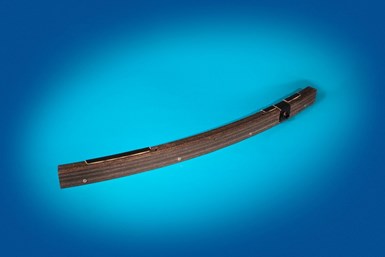
The auto industry’s first curved pultruded bumper beam on 2020MY Chevrolet Corvettes was produced by Shape Corp. using the radius-pultrusion process and equipment developed by Thomas GmbH + Co. Technik + Innovation KG. (Bremervörde, Germany) Source | SPE Automotive
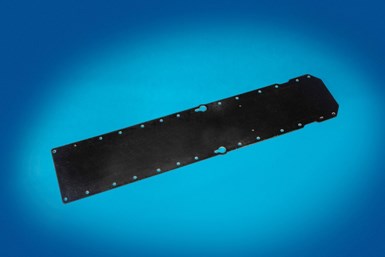
This underbody tunnel closeout was produced via liquid compression molding (LCM) using both carbon fiber (two layers) and glass fiber (three layers) impregnated with a vinyl ester matrix. Source | SPE Automotive Division
The Corvette wasn’t the only composite-intensive GM vehicle in the competition. The automaker also nominated its CarbonPro carbon fiber-reinforced thermoplastic composite pickup box on the 2019MY GMC Sierra Denali and AT4pickups. Continental Structural Plastics, a Teijin co. (Auburn Hills, Mich., U.S.) was the molder and tier integrator.
Hyundai Motor Co. (Seoul, Korea) has established a reputation of developing innovative and unusual polymeric materials to solve tricky engineering problems. This year the company was back with polypropylene (PP) door panels on 2017MY Hyundai Elantra sedans that were reinforced with glass wool. The filler, which involves recovering fiberglass insulation from the construction industry and grinding it with sand, is said to improve long-term scratch resistance and dimensional stability, while reducing mass and cost. Seoyon E-Wha (Seoul, Korea) was molder/tier integrator and toolmaker.
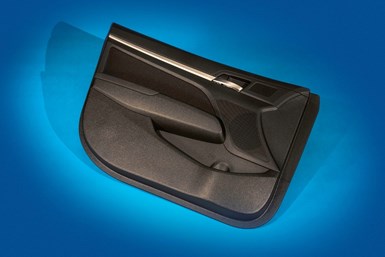
One of the more unusual materials in this year’s competition was a glass wool/polypropylene composite formulated to improve scratch and mar on door panel inners. The application also gives new life to old fiberglass insulation, which is notoriously hard to recycle and gums up incinerators when parts are burned. Source | SPE Automotive Division
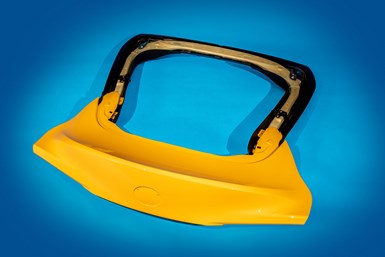
An innovative composite brake pedal on 2020MY Porsche 911sports cars and Taycan electric vehicles from Volkswagen AG (Wolfsburg, Germany) also was nominated. Produced by BogeRubber & Plastics (Damme, Germany) using unidirectional thermoplastic tapes, long-fiber thermoplastic (LFT), and fiberglass fabric-reinforced organosheet — all with a polyamide 6 (PA6) matrix. By replacing LFT/organosheetwith the tape/LFT/organosheetcombination, mass was reduced, driving haptics were improved and cost was neutral or lower, depending on model.
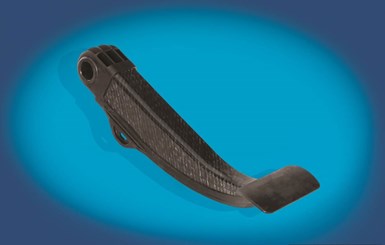
A high-volume thermoplastic composite brake pedal was produced in Germany using a hybrid layup and molding process on bespoke equipment. Source | Boge Rubber & Plastics and SPE Automotive Division
Another innovative Boge part nominated on 2020MY Jeep Cherokee sport-utility vehicles (SUVs) by FCA NA LLC (Auburn Hills, Mich., U.S.) replaced diecast and machined aluminum on the front bracket of the rear differential module. Injection molded in 50% glass-reinforced PA 6/6, the composite was said to not only reduced mass 30% and cost $1 per vehicle, but eliminated corrosion, provided 10-times higher damping, which, in turn, improved noise/vibration/harshness (NVH), and significantly reduced tooling costs over the life of the program.
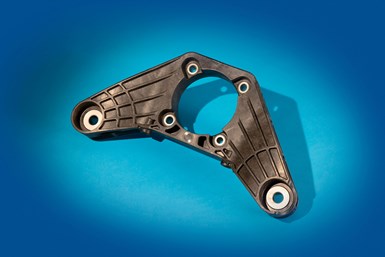
An injection molded glass/PA 6/6 bracket on the rear differential module replaced aluminum at lower mass and cost and better NVH. The tough composite had to meet stringent requirements and provide seamless integration into then-current production. Source | SPE Automotive Division