In my previous column (February 2020 issue of metalForming), I stated: “For metal formers, one of the simplest and oldest tests is the tensile test.” This column discusses the bulge test—nearly as old, with the earliest test setups built in the 1910s—digital image correlation (DIC), and the ISO 16808 standard, written in 2014.
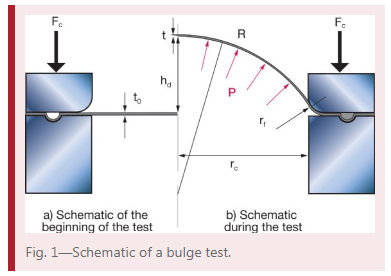
To conduct a bulge test, an operator clamps a thin sheet (t0 < 3 mm, 11 gauge or higher) between a die and a blankholder with lock beads (Fig. 1a). Under pressure, the sheet forms a dome-like shape (Fig. 1b) and we record dome height (hd) and internal pressure (P). The test continues until the sheet bursts. Note: Performing this test on advanced high-strength steels, with high ductility and strength, can lead to very high-energy bursts.
Using a Bulge Test
Performing a detailed metal forming simulation requires three data sets (or graphs) that emulate the sheet metal’s properties (Fig. 4):
- True stress/true strain curve, possibly at high strains;
- Forming limit curve (FLC); and
- Yield locus.
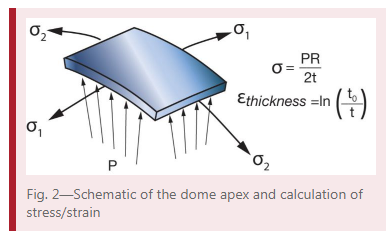
With a bulge test, we calculate true stress and true strain using the formula shown in Fig. 2, where the biaxial (two-axial) true stress equals internal pressure (P) times dome radius (R), divided by two times the instant thickness (t) at the apex. True strain is calculated from the logarithm of thickness change, similar to a tensile test.
The Need for DIC
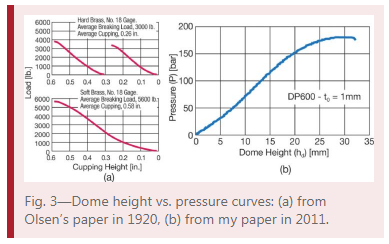
To calculate stress/strain, we must know the bulge radius (R) and thickness (t) values at several time steps during the test. While most test setups can record dome height (hd) and pressure (P) (Fig. 3), over the years many researchers, including myself, have tried to develop approximations that predict bulge radius and instant thickness from the dome height.
To do that, we assumed a perfectly hemispherical dome shape. However, it is not. We also assumed a balanced biaxial strain—the same value in north-south and east-west directions. Guess what? It is not. In fact, the difference between the strain in both directions provides us with a new material property, biaxial anisotropy (Rb), now incorporated into advanced material models in several finite-element softwares.
An additional reason to use DIC: the ISO standard requires it.
How DIC Affects the Bulge Test
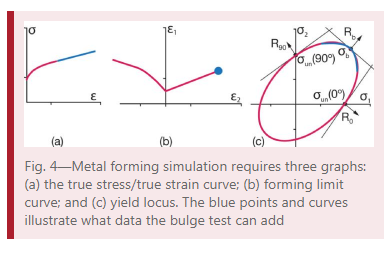
First of all, DIC almost killed the need for the bulge test, since gathering true stress data at high strains used to represent one of the most important reasons to conduct a bulge test (Fig. 4a). Now, we can gather this data when performing a tensile test with DIC.
Other uses for the bulge test:
With DIC, we can use the bulge test to measure failure strain, and simply put one of the points onto the forming limit curve (Fig. 4b).
We can measure two new material properties: biaxial anisotropy (Rb) and biaxial yield stress (σb), in order to calculate advanced yield locus such as Corus-Vegter or the simplified version, Vegter Lite (Fig. 4c). I will write in more detail about these advanced material models in future metalForming magazine columns.