Scientists at UC San Diego have discovered a new anode material that enables lithium-ion batteries to be safely recharged within minutes for thousands of cycles. Known as a disordered rocksalt, the new anode is made up of earth-abundant lithium, vanadium and oxygen atoms arranged in a similar way as ordinary kitchen table salt, but randomly. It is promising for commercial applications where both high energy density and high power are desired, such as electric cars, vacuum cleaners or drills.
The study, jointly led by nanoengineers in the labs of Professors Ping Liu and Shyue Ping Ong, was published in Nature on September 2.
Currently, two materials are used as anodes in most commercially available lithium-ion batteries that power items like cell phones, laptops and electric vehicles. The most common, a graphite anode, is extremely energy dense—a lithium ion battery with a graphite anode can power a car for hundreds of miles without needing to be recharged. However, recharging a graphite anode too quickly can result in fire and explosions due to a process called lithium metal plating. A safer alternative, the lithium titanate anode, can be recharged rapidly but results in a significant decrease in energy density, which means the battery needs to be recharged more frequently.
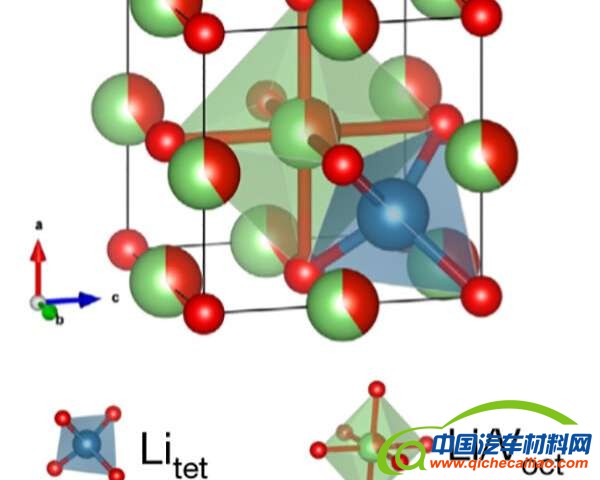
The crystal structure of disordered rocksalt -- Li3V2O5. The red balls represent O, the blue tetrahedron represents Li in tetrahedral sites, and the green octahedron represents the Li/V shared octahedral sites.
Credit: Liu and Ong labs, UC San Diego
This new disordered rocksalt anode—Li3V2O5 —sits in an important middle ground: it is safer to use than graphite, yet offers a battery with at least 71% more energy than lithium titanate.
"The capacity and energy will be a little bit lower than graphite, but it's faster, safer and has a longer life. It has a much lower voltage and therefore much improved energy density over current commercialized fast charging lithium-titanate anodes," said Haodong Liu, a postdoctoral scholar in Professor Ping Liu's lab and first author of the paper. "So with this material we can make fast-charging, safe batteries with a long life, without sacrificing too much energy density."
The researchers formed a company called Tyfast in order to commercialize this discovery. The startup's first markets will be electric buses and power tools, since the characteristics of the Li3V2O5 disordered rocksalt make it ideal for use in devices where recharging can be easily scheduled.
Researchers in Professor Liu's lab plan to continue developing this lithium-vanadium oxide anode material, while also optimizing other battery components to develop a commercially viable full cell.
"For a long time, the battery community has been looking for an anode material operating at a potential just above graphite to enable safe, fast charging lithium-ion batteries. This material fills an important knowledge and application gap," said Ping Liu. "We are excited for its commercial potential since the material can be a drop-in solution for today's lithium-ion battery manufacturing process."